Private Guided Tour of Montepulciano with wine tasting
Two hours on foot with a private guide, meeting in front of the city hall on Piazza Grande. Your party only, and a tasting at the end of the walk.
From $154 per person
Check AvailabilityThe town itself is free, and four things on and below the hill charge. That is the whole of it, and it means a good day here costs whatever you decide to drink. If you are pricing Montepulciano ticket prices, this page is the list of what your money actually buys.
Nobody sells a ticket to Montepulciano. You walk in through Porta al Prato and you walk out again, and in between these are the doors you pay at.
| What it is | Full price | Reduced | Season and hours |
|---|---|---|---|
| Walking the town | Free | Free | There is no gate and no closing time |
| Torre del Palazzo Comunale and the terrace | €5 | €2.50, and free under 10 | Daily 10:00–18:00, last entry 17:45, through the season |
| Museo Civico Pinacoteca Crociani | €6 | €4 | 1–30 April 10:00–18:00; 1 May–31 October 10:00–19:00 |
| Tower and museum together | €8 | €6 | Whichever you are standing in front of |
| Tempio di San Biagio | €5 | Free under 6; audioguide free in five languages | Six bands through the year; 1 April–30 September daily 10:00–13:30 and 14:00–18:30 |
Piazza Grande is the highest point in the town and the only square that is not on a slope. Five buildings box it in, and once you know which is which the square stops being a photograph and starts being a place.
The Corso is the spine of the town and it climbs the entire way. Start at Porta al Prato at the bottom and you have perhaps twenty-five minutes of walking ahead of you, plus however long you stop. Take it slowly; there is no prize for arriving out of breath.
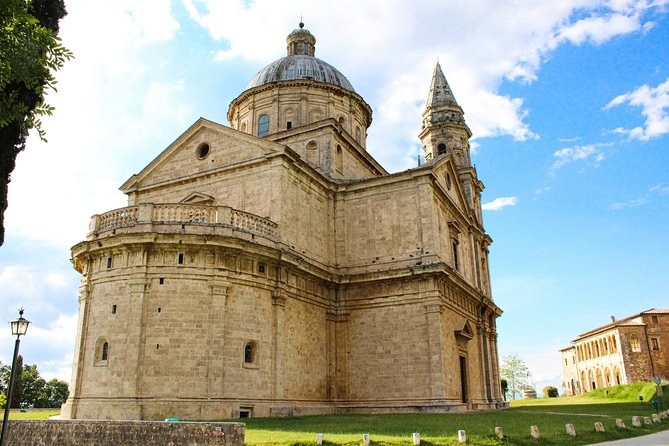
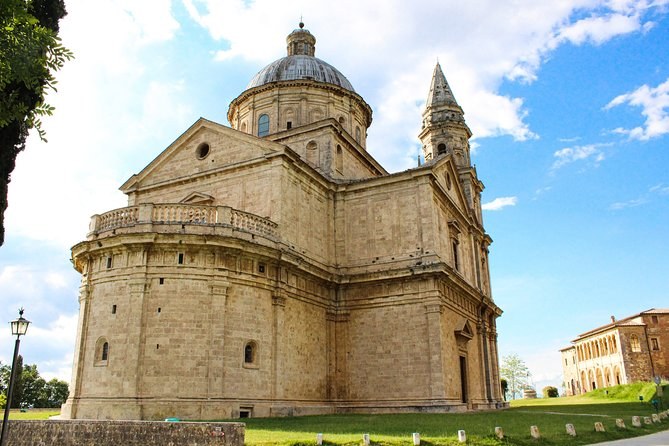
The one building here that is worth the walk on its own account stands outside the town entirely, alone on a lawn at the bottom of an avenue of cypresses. Antonio da Sangallo il Vecchio began it in 1518, and it is a Greek cross in honey-coloured travertine with nothing built up against it.
It is about fifteen minutes down from the walls and rather longer back, which is the detail the photographs leave out. Admission is €5 and the audioguide is free in five languages. The e-bike day rides down to it and the coach days from Rome stop for a photograph on the way past.
The museum sits in the 14th-century Palazzo Neri Orselli on Via Ricci, a few doors from two of the cellar entrances. Its core is a bequest of 188 paintings made in 1861 by a canon of the cathedral, mostly Florentine and Bolognese work of the 17th and 18th centuries, with some Dutch pictures alongside.
Among them are a Sodoma, a panel by Margaritone d'Arezzo, a Nativity given to Benvenuto di Giovanni, and a portrait of a man recently attributed to Caravaggio. It is a small collection and an hour does it, which makes the €8 combined ticket with the tower the sensible buy on a wet afternoon.
The Medici fortress at the top of the ridge is Sangallo il Vecchio's too, and it is now a public building rather than a monument with a turnstile. What you come for is the edge: the walls on this side look straight down over the vineyards, and the light in the late afternoon is the best you will get all day.
New Moon used this town as a stand-in for Volterra, and the listings sell that in their own copy. The scenes people arrive looking for are on and around Piazza Grande, and the square is small enough that you will find them without a guide. It takes ten minutes.
A day here works perfectly well dry, which is not true of every town in this part of Tuscany. The tower, the terrace, the Museo Civico, the temple below the walls and the whole climb of the Corso are the day, and none of them involves a glass.
Prices and hours are the comune's own season notice and the temple's own site, both checked 20 September 2026. The buildings round Piazza Grande, the museum's bequest and the Palazzo Comunale's dates are published records, read the same day. Everything about a tour is its own listing's.
Two hours on foot with a private guide, meeting in front of the city hall on Piazza Grande. Your party only, and a tasting at the end of the walk.
From $154 per person
Check Availability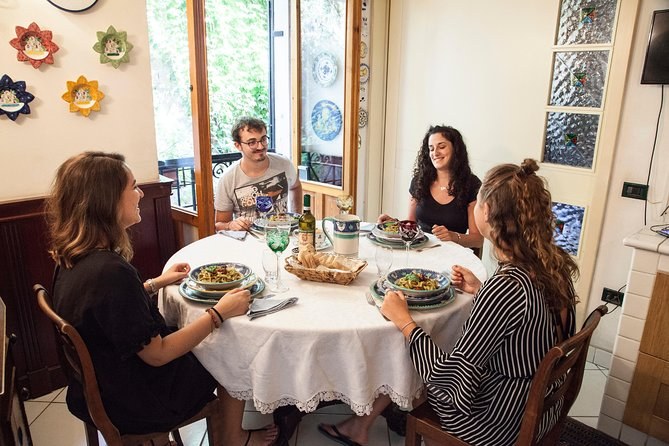
Two and a half hours at a local host's table in Montepulciano: you watch the cooking, then eat three courses with wine and coffee. The address comes after booking.
From $128 per person
Check Availability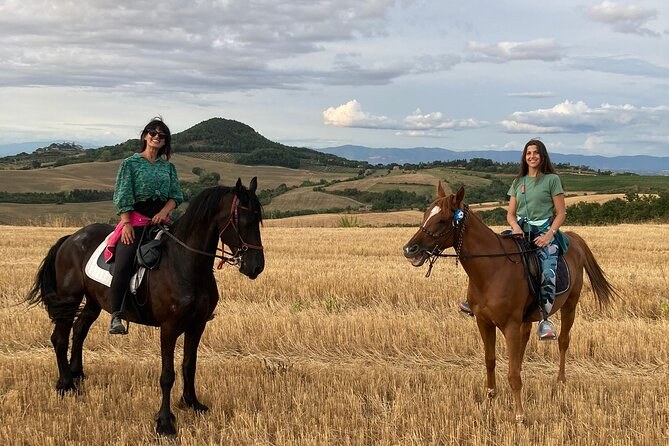
An hour and a half in the saddle through the vineyards, out at Localita Bertille. Bottled water and coffee rather than a tasting, and the best view of the vines that does not involve pedalling.
From $93 per person
Check AvailabilityNext: read what is in the glass on the vineyards page, find the car parks and the climb on the map, or compare every tour on Montepulciano Tours.